-- Travel and Immigration 101

Monday, February 24, 2014

Maasin City, Southern Leyte's Town with Glorious Past

In an unruffled rural setting in Southern Leyte, lies a city draped by remnants of its glorious past. Maasin, the capital of the province blissfully sits on the western coast and is largely not a tourist favorite. Not much is written about the points of interest in this tranquil metropolis, but intrepid travelers curious to explore this part of the country will be rewarded with interesting treks, immaculate waterfalls and uncharted caverns.
 Getting here requires extra stamina since the closest airport is located in Ormoc roughly 3 hour drive or you may also reach Maasin via Tacloban in approximately 4 hours by land. Alternatively, you can ride a ferry from Cebu or if coming from Mindanao, you can take the route I took which also entails a degree of travel discomfort – board a ferry at Lipata Port in Surigao City to Liloan, Southern Leyte and hop on a bus bound to Maasin.
 At the downtown area, the modest streets are clad by forgotten colonial-era houses. The massive 17th century Maasin Cathedral looms over the central square fringed by buildings important to city life including the Municipal Hall. Adjacent to it is the age-old school of St. Joseph College established way back in 1928 and ruins of an old Spanish balaurte (watchtower).
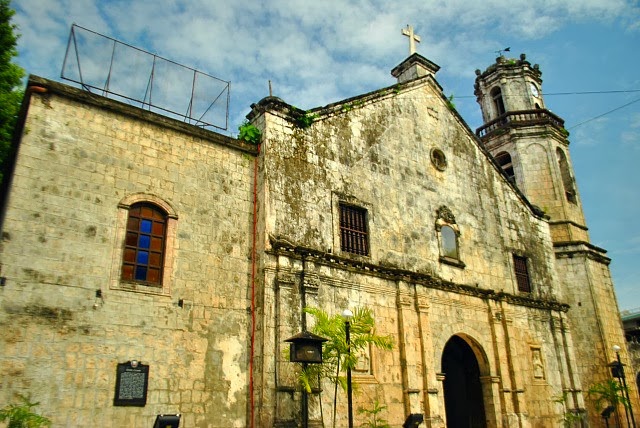
The cathedral’s interior is enhanced by a beautifully painted ceiling showing images of saints; however the modern altar seems to contradict the archaic elegance of the entire edifice. Its ochre colored walls were built out of coral stones. The Maasin Cathedral began its constructions during the time of Jesuit priest Fr. Serapio Gonzalez and continued from 1839 to 1852 under the guidance of Fr. Jose Paco. Unfortunately in 1884, the church was devastated by fire but was later restored.

Maasin beckons Catholic devotees because of a number of pilgrimage sites scattered around the city. The most accessible is the Shrine of Mother Mary that provides a tranquil refuge to weary visitors. It is believed to be the tallest privately owned shrine in the country. The colossal statue crowns Jaleca Hills and offers a scenic view of Maasin shoreline.

If you have the luxury of time, pay a visit to the lovely Monte Cueva Asuncion de la Virgen Shrine (Shrine of Our Lady of the Assumption and Precious Blood of Jesus), a cave perched on top of a hill transformed into a humble chapel.

Wednesday, February 19, 2014

Canada Immigration Closed for Parents and Grandparents

The Parent and Grandparent sponsorship programme has reached the maximum number of applications that will be accepted this year, Citizenship and Immigration Canada (CIC) announced last week.
It was a short-lived moment of euphoria for those families who had been waiting to reunite through the immigration programme that allows Canadian residents to sponsor their parents or grandparents.

As the programme re-opened this January, with much fanfare after two years, it reached the 5,000 intake cap within one month.

Now, the programme has been closed again, for at least one year.

On January 2, the CIC re-opened the Parents and Grandparents sponsorship programme for application, promising to accept 5,000 new applications this year.

In general, the Canadian government committed to welcoming 20,000 new parents and grandparents to Canada, drawing the remaining 15,000 candidates from the existing backlog of applicants.

Due to a backlog of applications and long processing times Citizenship and Immigration Canada (CIC) had stopped accepting applications for the immigration stream on November 5, 2011.

Since then, CIC has been pursuing the Action Plan for Faster Family Reunification, aiming to reduce the backlog.

In 2012-2013 it admitted approximately 50,000 parents and grandparents as Canadian permanent residents.

It also made permanent the Super Visa Programme, which allows parents and grandparents to enter Canada as long-term visitors.

In addition, it developed a renewed Parents and Grandparents stream, with the promise of faster processing times and a number of new requirements. Among some of these requirements were the increase of the minimum necessary income (MNI)  by 30 per cent, an extended period of demonstrating funds from one year to three, an extended sponsorship undertaking period to 20 years instead of 10, and reduction in the maximum age of accompanying dependents to 18 years or younger.

Commenting on the closure of the programme, the CIC said: “As the CIC has now received 5,000 complete applications, new intake into the Parent and Grandparent programme will again pause until next year, as we devote our energy to reuniting more families.

“By the end of 2014, we expect to welcome an additional 20,000 parents and grandparents to Canada, marking a substantial reduction in wait times for all applicants.”

Citizenship and Immigration Minister Chris Alexander said: “Our government understands the importance of spending time with family and loved ones and we committed to improving the immigration system so that families can be reunited more quickly.

“Canada has the most generous family reunification programme in the developed world.

Complementing this programme, the new Super Visa remains a convenient option with a high approval rate for those who wish to visit their families in Canada for up to two years at a time.”

The CIC encourages applicants who were unable to apply for the 2014 programme to consider the option of the Super Visa, which provides parents and grandparents of Canadian citizens and permanent residents with a visitor visa that can be renewed for two years at a time, for a period of up to 10 years.

Around 1,000 applications are accepted every month, and 87 per cent of the applications on average are approved.

Monday, February 3, 2014

Working Holiday Scheme (WHS) Visa Allows Filipinos to Study and Work in NZ for 1 year

Filipinos and New Zealanders between 18 and 30 can now go to New Zealand and the Philippines and stay for a year through a Working Holiday Scheme (WHS) visa that allows them to work and stay for holiday and leisure, the Department of Foreign Affairs (DFA) reported on Monday.
Starting Feb. 5, Filipinos and New Zealanders can apply for the special visa, which allows both citizens to train or study for a maximum period of three months, or work for one year with a limit of three months per employer. Visa holders will have to leave the host country after 12 months and only 100 visas per year per country will be issued to successful applicants, DFA said.

The arrangement on the special visa was signed between Secretary of Foreign Affairs Albert Del Rosario and Minister of Foreign Affairs Murray McCully and witnessed by President Benigno S. Aquino III and Prime Minister John Key in Wellington last October 23.

Implementation of the WHS is expected to foster closer understanding between citizens of both nations through tourism, cultural and educational exchanges and short-term employment.

Interested applicants from the Philippines may contact the Embassy of New Zealand in Makati (http://www.nzembassy.com/philippines) while those from New Zealand can get in touch with the Embassy of the Philippines in Wellington (http://www.philembassy.org.nz/) for the requirements and relevant details of the WHS arrangement.

Thursday, January 30, 2014

HK Cancels Visa-Free Travel for Filipino Diplomatic, Official Passport Holders

Hong Kong will suspend visa-free travel for Filipinos holding diplomatic and official passports starting February 5, amid political tensions over the Manila bus hostage crisis.
Regular passport holders are not affected for now. An official passport is issued to government officials and those who hold diplomatic posts abroad while a diplomatic passport is issued to Philippine diplomatic service members, Cabinet officials, service attachƩs and Filipino delegates to international institutions.

“To visit Hong Kong, holders of these passport will have to apply for a visa beforehand in accordance with normal procedures in the immigration department of Hong Kong or Chinese and consular missions overseas,” Hong Kong leader Leung Chun-ying said in a press briefing.

The new sanction comes after talks over a Philippine apology to relatives of Hong Kong citizens killed in the 2010 fiasco broke down, Leung said. Leung laments that “the Philippine side is still unable to meet the demand of the victims and their families for a formal apology.”

“The victims and their families and the SAR government agree the response is unacceptable,” Leung added, noting that the sanction is just the first phase. Under the erstwhile agreement, holders of official and diplomatic Philippine passports may stay in Hong Kong for 14 days without a visa.

“The sanctions that we have announced are just and justified. We welcome the continuation of dialogue between Hong Kong and the Philippines to bring the matter to a final conclusion,” Leung said further. Prior to the travel sanctions, Hong Kong lawmakers have urged their government to impose limits tighter rules on hiring Filipino workers.

There is also a long-standing warning to Hong Kong citizens looking to travel to the Philippines. Leung has not specified other sanctions it will impose on the Philippines over the tragedy and whether or not this will include economic restrictions.

On August 23, 2010, eight tourists from Hong Kong died after they were hostaged by disgruntled policeman Rolando Mendoza. The Manila bus hostage crisis lasted for 10 hours and was aired live in major news outfits around the world. Separate probes have since been launched by both Hong Kong and Philippine governments, with Hong Kong demanding a formal apology from President Benigno "Noynoy" Aquino III.

Recently, Manila Mayor Joseph Estrada issued an apology for the bus crisis. Government data show that more than 160,000 Filipinos are now in Hong Kong, most of them workers. Total trade between the two countries meanwhile amounted to some $6.2 million in 2012.

Friday, January 24, 2014

DFA Raises Alert Level for Bangkok

The Department of Foreign Affairs (DFA) raised yesterday the alert level for Bangkok and neighboring provinces placed under a 60-day state of emergency amid the political unrest there.
From alert level 1 or precautionary phase, the DFA raised it to 2 or restriction phase.

This means Filipinos in Thailand should restrict non-essential movement, avoid public places and prepare for evacuation.

Alert level 2 is issued when there are real threats to the life, security and property of Filipinos arising from internal disturbance or external threat.

The DFA said the situation remains fluid and volatile in Bangkok, particularly in anti-government protest areas, in spite of efforts to maintain a state of normalcy.

The Philippine embassy in Bangkok had advised Filipinos with essential travel plans and those residing in Bangkok and other parts of Thailand to avoid rally sites and large gatherings and refrain from taking part in the protest or other political activities.

Filipinos are also advised to exercise extreme caution and vigilance and monitor developments.

The embassy said it is ready to extend assistance to all Filipinos in Thailand.

Filipinos were also cautioned by the embassy against wearing red or yellow shirts lest they be mistaken for government or anti-government parties.

“Participating and/or showing support in any form to any of the parties is strongly discouraged. For information, the red and yellow colors are closely identified with some of the parties involved,” the embassy said.

Records at the Commission on Filipinos Overseas showed there are 16,303 permanent, temporary and irregular Filipinos in Thailand as of December 2012.

Meanwhile, MalacaƱang gave assurance the DFA would investigate alleged abuses by Malaysian authorities against Filipinos working there.

In a press briefing, Presidential Communications Operations Office Secretary Herminio Coloma Jr. said justice must be served to those who were beaten up and subjected to other forms of harassment in the crackdown in Malaysia.

He said the Philippines is treating foreigners well and it is expected that Filipinos would enjoy the same treatment elsewhere.

Reports said Malaysian authorities began a crackdown on illegal migrant workers, particularly those from Indonesia, the Philippines, Bangladesh, Myanmar and Thailand.

Malaysian Interior Minister Ahmad Zahid Hamidi was quoted as saying that those found without valid documents would be deported within seven days.

Coloma said the Philippines and Malaysia have a long history of friendship and cooperation, adding that Malaysian authorities are expected to pay special attention to the plight of Filipino workers.

He said the DFA should also give details of the alleged harassment and abuses reportedly committed against Filipino workers.

In Kota Kinabalu, architect Florito Rosales said he was among 311 Filipino workers rounded up by Malaysian authorities on Jan. 21.

Radio reporter Florante Rosales said his brother told him that Filipinos were thrown in overcrowded jails, beaten and forced to admit they were illegal workers.

Related Posts Plugin for WordPress, Blogger...

 
Design by Wordpress Theme | Bloggerized by Free Blogger Templates | free samples without surveys